
Transforming Diagnostic Accuracy with DeepQ

Every diagnosis begins with a story
The patient’s history, examination findings, and test results woven together by the clinician’s expertise. But in modern healthcare, the story is often fragmented: records scattered across systems, rapidly changing guidelines, time pressures, and information overload. These challenges contribute to diagnostic delays and errors that affect patient outcomes and clinician confidence.
At Deep AI Lab, we believe the next leap in clinical care comes from combining trustworthy AI with the rigor of evidence-based medicine. Our flagship platform, DeepQ is designed to support clinicians in making more accurate, timely, and explainable diagnostic decisions. The platform comes with a permission-aware conversational knowledge agent powered by state-of-the-art LLMs and Advanced Retrieval Augmented Generation (RAG) with deep domain-aware contextual intelligence.
Where Clinicians Struggle Today
Even the most skilled clinicians face barriers that compromise diagnosis. Diagnostic errors remain a leading cause of preventable harm worldwide.
- Information overload and time pressure: Synthesizing patient histories, labs, and imaging across multiple systems leaves little time for deep reasoning.
- Fragmented records: Data locked in silos makes it difficult to see the complete clinical picture.
- Keeping up with guidelines: Medical knowledge is doubling rapidly, and adherence to evolving best practices varies widely.
- Testing pitfalls: Suboptimal test ordering or interpretation delays lead to missed or late diagnoses.
- Decision support fatigue: Traditional clinical decision support system (CDSS) tools are often rigid, poorly integrated, and underutilized due to low clinician trust.
DeepQ addresses the above challenges through its deep contextual intelligence, real-time updated centralized knowledge bank, pre-built specialized agents designed for clinicians, and robust permission-aware capabilities.
How DeepQ Helps Clinicians Diagnose Faster and Smarter
Sharpening diagnostic accuracy
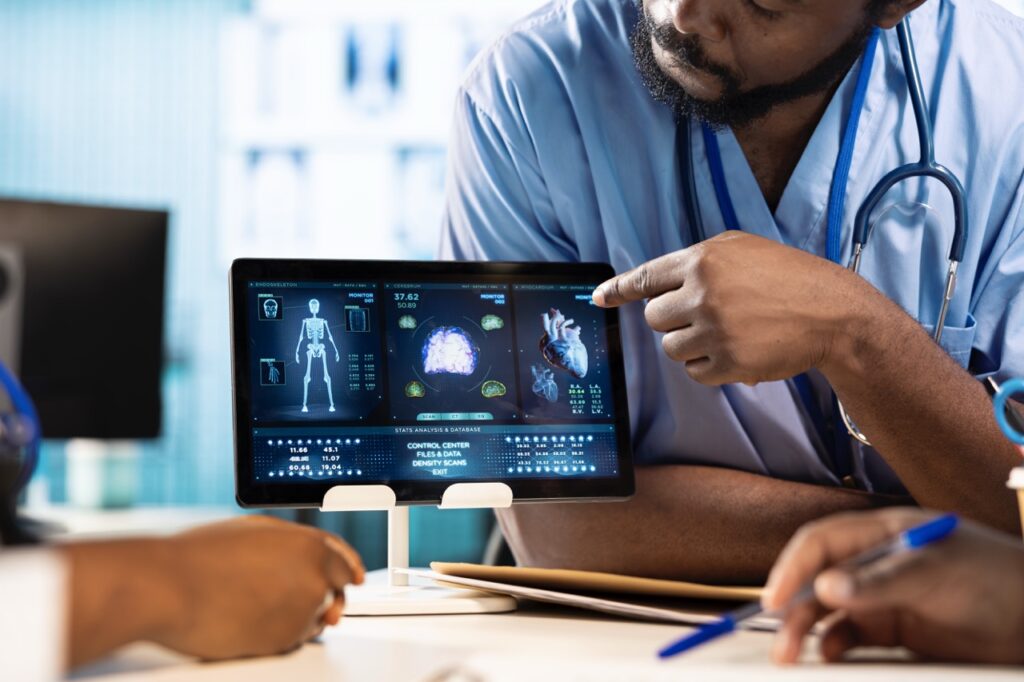
DeepQ retrieves relevant patient data, guidelines, and institutional protocols in real time, then synthesizes ranked differential diagnoses and suggests next steps including citations back to the source. This improves accuracy of the diagnostic procedures by 20-30%.
Reducing cognitive overload
Instead of sifting through dozens of notes and lab results, clinicians receive concise, prioritized insights and action lists tailored to the patient. As a result, 20–30% reduction in time spent on information gathering per patient.
Enforcing guideline adherence
DeepQ matches patient context against the latest clinical guidelines and local policies, flagging gaps or deviations. This helps the hospitals to achieve 20-40% improvement in adherence to the standards of care on diagnostic pathways.
Smarter testing pathways
By considering pre-test probabilities and evidence-based sequences, DeepQ helps avoid unnecessary tests and cascade errors. As a result, 10–25% improvement in diagnostic yield per test can be observed.
Building trust through transparency
Every answer includes document provenance, and auditable logs. Clinicians see why DeepQ suggested a diagnosis through the explainability feature (xAI) linked with the answers.
Easy integration with hospital systems
DeepQ is designed to work within existing digital ecosystems, not replace them. Key integration points include,
- EHRs via FHIR APIs for seamless data exchange.
- LIS and PACS to incorporate lab and imaging results into reasoning.
- Knowledge repositories such as internal guidelines, SOPs, and research libraries ingested into the advanced knowledge engine.
Secure knowledge access
Identity and access controls that ensure clinicians only see information they are authorized to view via the DeepQ web portal. DeepQ ensures responses are generated only from data each clinician is authorized to access, delivering secure, compliant, and trustworthy intelligence.
This means hospitals can adopt DeepQ without disrupting existing workflows while enhancing safety, speed, and consistency.
The following diagram depicts the high-level integrated architecture of the DeepQ platform
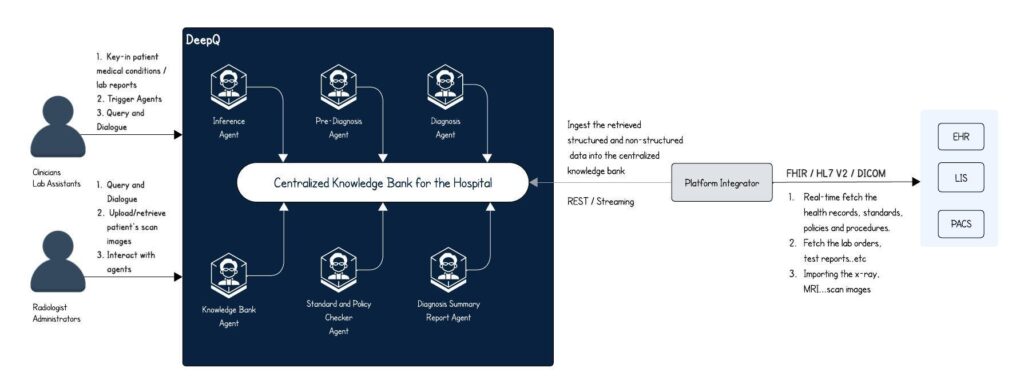
- Pre-Diagnosis Agent: Automatically validates patient’s information/documents for completeness, consistency, and authenticity.
- Knowledge Bank Agent: Indexes verified documents into DeepQ’s centralized Knowledge Bank for intelligent retrieval and reasoning.
- Diagnosis Agent: Retrieves relevant patient data, guidelines, and institutional protocols in real time, then synthesizes ranked differential diagnoses and suggests next steps including citations back to the source.
- Standard and Policy Checker Agent: Evaluates the proposed diagnostic plan against the hospital’s standard and policy, and any compliance frameworks.
- Diagnosis Summary Reporting Agent: Generates the summary report including the all the procedures carried out as part of the diagnosis and next steps.
- Inference Agent: Generates deep context aware responses for the queries from the users, having a realistic and human nature dialogue with the them.
What Should a Hospital Do Next?
Rolling out DeepQ is a journey, not a flip of a switch. We partner with hospitals through:
- Discovery workshops to identify the most impactful clinical use cases.
- Pilot programs in targeted departments (ED or internal medicine) with measurable KPIs on accuracy, time, and guideline adherence.
- Integration and scaling into enterprise EHR and workflow systems.
- Continuous monitoring for safety, trust, and performance.
Together, we can bring safer, faster, and more reliable diagnoses to the point of care, empowering clinicians and protecting patients.
Conclusion
DeepQ doesn’t replace doctors, instead it makes them stronger, faster, and better supported in the critical decisions that matter most. With the DeepQ at their side, clinicians can focus more on patients and less on paperwork, and make accurate, timely, and explainable diagnostic decisions.